


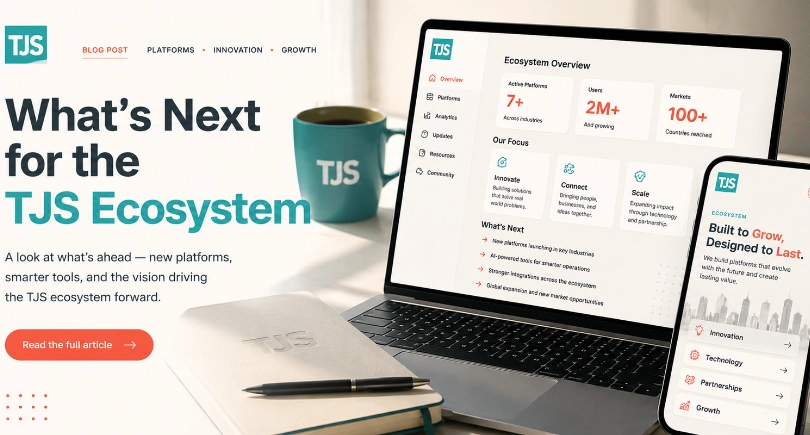
People ask what we are building next.
The honest answer is that the specific products matter less than the direction behind them. Individual platforms will launch, grow, and in some cases change into something we did not originally plan. What stays constant is what we are building toward.
We are building an ecosystem of platforms people use every day.
An Ecosystem, Not a Product Line
There is a difference between a portfolio and an ecosystem.
A portfolio is a list. A company owns several products, and the only thing connecting them is the name on the paperwork. Each one is built from scratch, staffed separately, and learns nothing from the others.
An ecosystem works differently. Each platform serves its own market with its own purpose and its own audience, but they share the layer underneath. The technology. The infrastructure. The operating experience. The knowledge of what breaks at scale and what users actually do when nobody is watching.
That shared foundation is the whole design of TJS Platforms. It is why we can move into business technology, marketplaces, professional services, media, commerce and emerging digital categories at the same time. Not because we are chasing every market, but because the underlying need in each one keeps turning out to be the same. People, businesses, information and opportunities need better ways to reach each other.
Strengthening What Is Already Running
The most important part of what comes next is not new at all.
Platforms already operating get better. That work is unglamorous and it never appears in an announcement, but it is where most of the value gets created. Removing friction users have learned to tolerate. Making a slow process fast. Building the feature people keep asking for in support tickets. Hardening infrastructure before growth forces the issue instead of after.
The Black Index is an example of the direction. Bringing local restaurants, professional services, technology companies and retailers into one place where they can actually be found is not a problem you solve once at launch. It gets better as more businesses join, as discovery improves, and as the people looking for them find what they need faster.
A platform that stops improving starts falling behind the day the market moves. So the first answer to what comes next is always the same. What we already operate.
Where We Look for the Next Platform
New platforms come from the same place they always have. Real problems, found while doing real work.
We watch for the same signals every time. Work that is still unnecessarily manual. Information that should be easy to find and is not. Industries running on processes that have not changed in decades because nobody built the alternative. Two groups who need each other and have no straightforward way to connect.
When we see one of those, the question is not whether we could build something. It is whether we should. Does it solve a problem people genuinely have? Can it scale? Can it evolve as the market changes? Can users depend on it? Does it get stronger as more people use it?
Plenty of ideas do not survive those questions, and that is the point of asking them. Deciding what not to build is as much a part of the direction as deciding what to build.
Each Platform Makes the Next One Easier
Every platform we launch and operate teaches us something the next one inherits.
Infrastructure that held up under load. Operational practices that caught problems early. Product patterns that worked, and just as usefully, the ones that did not. Knowledge about what users actually do rather than what a requirements document predicted.
That compounding is the real asset. A company launching its first product starts from nothing, learns expensive lessons in public, and hopes to survive them. We start each new platform with everything the previous ones cost us to learn.
It also means our capacity to launch grows over time rather than staying flat. Shared technology, shared infrastructure and shared operating capability mean the next platform does not require rebuilding the foundation before the product can even begin.
What Will Not Change
The markets will change. The technology will change. Some platforms will end up in industries we are not in today and serving users we have not met yet.
The approach behind them stays the same, because it is the part that works.
We identify problems worth solving. We build the technology and the infrastructure to support them. We launch each platform with its own product, brand and market. We operate what we build. We scale what works. And we keep evolving it as expectations move.
We are not building products simply to launch them. We are building technology businesses meant to last, which means every decision gets made with an eye on what a platform needs several years from now, not just what gets it live.
Still Early
We are early in this story, and that is a deliberate way to describe it.
There is more to build than we have built. More markets where the connection between people and businesses is harder than it should be. More work that technology could make faster, clearer and less manual.
The goal was never to put more software into the world. It is to build technology people actually use, and platforms that make it easier for people and businesses to connect.
The next platform is already being built.